Richard "Dick" Howden
Early Life & Perseverance
Richard "Dick" Howden was born a twin with Robert "Bob" on March 13, 1920, in Morgan Park near Duluth, Minnesota. Delivered by Dr. W. J. Ryan, Dick and his twin brother Bob faced immediate challenges when their mother fell ill and required extended hospitalization. The twins were placed with separate families during her recovery.
The family Dick was placed with didn't follow medical orders, and he developed rickets. "By the time I was two or three years old, I was so bowlegged that a pig could run between my legs," he later recalled. This began a lifetime of medical challenges that would test his resolve but never break his spirit.
The surgery required a six-month hospital stay. "I remember it vividly, being in a hard cast from my waist down to my feet." Further complications arose in April 1937 when his left knee locked, requiring additional surgery and five months in a walking cast. Returning to high school on crutches with a full leg cast, navigating a two-story building, he came to a realization: "It was then that I realized I had something I was just going to have to live with."
Despite these challenges, Dick graduated high school in 1940 and pursued his dream of becoming a lawyer at the University of Miami on scholarship, though his path would ultimately lead him to serve justice in a different way.
Related Images
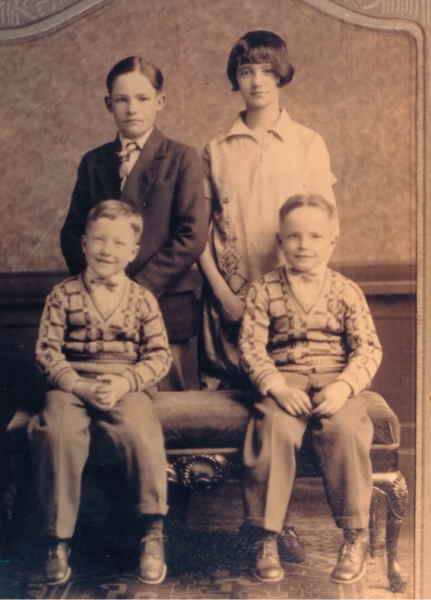
Bob, Dick, Margaret Elinore, and William Patrick
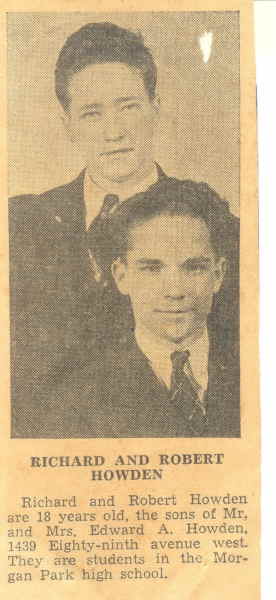
The Howden Twins - Bob and Dick
Military Service & Sacrifice
After being turned down four times by the US Army due to his physical condition, Dick returned from his University of Miami studies to work at the US Steel plant in Morgan Park. When he received a draft notice in 1941, he was inducted into the US Army at Fort Snelling, St. Paul, Minnesota, on August 31, 1942—somehow passing the physical examination that had previously rejected him four times.
As a PFC in the 858th Signal Corps, Dick was sent for basic training at Williams Field in Arizona. For three months, he endured rigid training including long daily hikes carrying heavy packs. By December, his right knee began to swell. "I reported to sick bay and when those doctors saw the x-rays, they immediately confined me to the hospital."
Transferred to William Beaumont General Hospital in El Paso, Texas, in January 1943, Dick faced a panel of about six doctors. "The one thing they all agreed on was how did I ever get into the Army." He received an Honorable Civilian Disability Discharge on March 18, 1943.
The loss of his twin brother deeply affected Dick, but it also strengthened his resolve to serve his community and honor his brother's sacrifice through dedication to law enforcement and justice.
Military Service
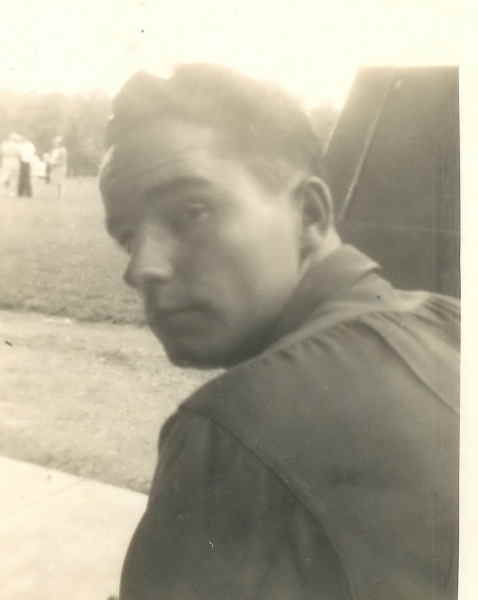
US Army Service
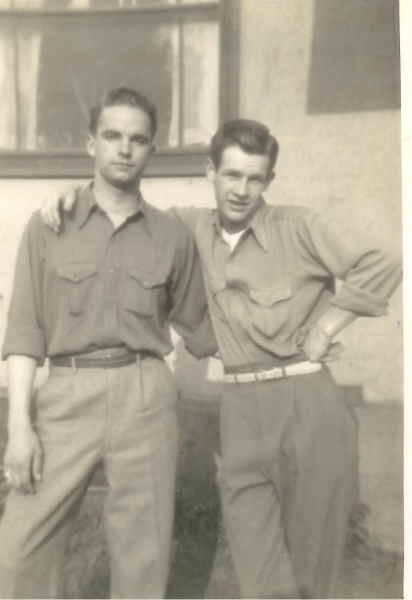
Twin Brother Bob
Law Enforcement Career
From Florida Highway Patrol to Dade County Sheriff's Office
Returning to Florida in fall 1943, Dick worked at Philbricks Funeral Home in Coral Gables. In July 1944, just months after losing his twin brother, he applied to the Florida Highway Patrol in Miami. "My knees were bothering me a little, but I thought I would give it a try." He passed the physical and was hired in September 1944.
In October 1945, Dick met Pauline Sue Varnedoe, a police dispatcher for the City of Miami Police Department who also dispatched the Florida Highway Patrol band. They married on October 26, 1945. Pauline was rememberd by saying, "He was so handsome in his uniform, tall and slender with dark hair and eyes."
During this time, Dick took correspondence courses in fingerprinting and photography from the Institute of Applied Science in Chicago, demonstrating his commitment to professional development. On September 15, 1945, he was appointed Superintendent of the Bureau of Identification, Dade County Sheriff's Office, Miami, Florida, while also serving as an investigator in the Homicide Bureau.
Dick's work required both technical expertise and strong constitution. He kept fingers in jars of formaldehyde for identification purposes, explaining how he would "cut off the fingers and put his own inside the skin to get a good print." He maintained an album filled with photographs from crime scenes and articles from police gazettes documenting famous and interesting cases. He did all his own photo developing and printing.
Dick was also secretary of the Dade County Association of Police Chiefs, an organization embracing all law enforcement agencies, including municipal, state, and federal. In June 1949, Dick was offered the position of chief of police for the city of Opa-Locka, Florida, but declined. We would later find out through his testimony during the Kefauver Commission exactly why he turned down the position, and why he left law enforcement in south Florida.
Unwavering Dedication Despite Physical Challenges
As their family grew, Dick transitioned in 1949 to work as an investigator with Equitable Life Assurance Society of America in Miami, where he would work until his forced medical disability in 1976. But the physical challenges that had marked his early life returned with devastating force.
In May 1952, after the birth of their third child, Dick's left knee locked. "I tried to get out of bed one morning and my left knee locked. My wife, Pauline, had to take me into the VA Hospital, Coral Gables, in a wheelchair." Emergency surgery followed. "That was the most pain I had ever had in my entire life. I had injections every four hours for 12 days for the pain. My knee joint was like a gravel pit."
Doctors told him he would never walk on his left leg again. He was fitted with a long leg brace—two flat steel rods with padded leather straps laced like ice skates. His first night home, overcome with frustration, he threw the brace across the room. "I told my wife, 'I'll never wear that thing again.' But, the next morning, I woke up and put it on, knowing I didn't have any other options." By November 1952, he needed a similar brace for his right leg.
"I did the same work as I always did, driving 3,000 miles a month, plus covering territory in Puerto Rico." He drove all over Florida and was often away for the births of his first five children. His determination was unwavering. "Plus, I liked my work. Only by the grace of God. If it wasn't for my faith, I don't think I could have done what I did."
Career Archives
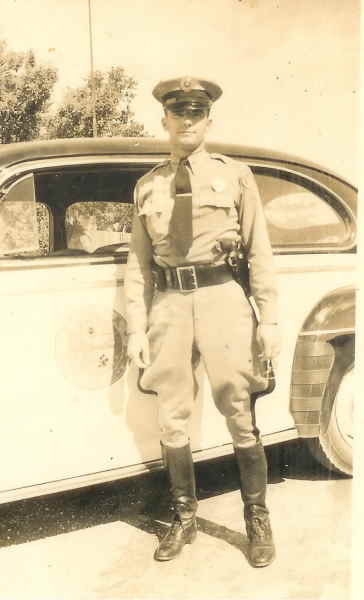
Florida Highway Patrol
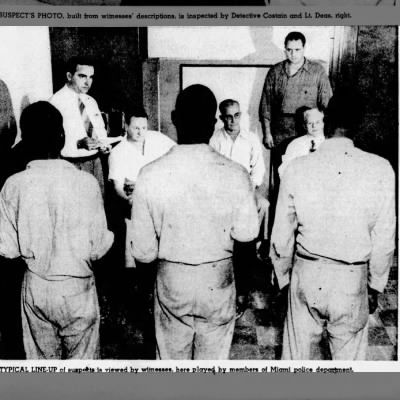
Dade County Sheriff's Office - Staging a line-up
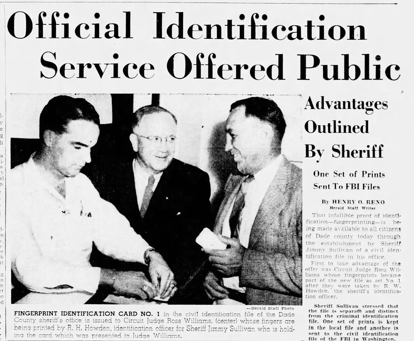
Homicide Investigation - Superintendent of the Bureau of Identification
The Kefauver Commission
United States Senate Special Committee to Investigate Crime in Interstate Commerce
Miami Field Hearings, 1950
In the early 1950s, Senator Estes Kefauver (Tennesee-D) led one of the most significant congressional investigations in American history. The Special Committee to Investigate Crime in Interstate Commerce, commonly known as the Kefauver Commission, held hearings across the country to expose the extent of organized crime's influence on American society. Among these was a field hearing held in Miami, Florida, where the committee investigated the relationship between local law enforcement and organized crime in South Florida.
At the Miami hearing, Richard "Dick" Howden demonstrated extraordinary courage by testifying against his own superior—Sheriff Jimmy "Smiling Jimmy" Sullivan. Drawing from his years of firsthand experience as Superintendent of the Bureau of Identification and investigator in the Homicide Bureau for the Dade County Sheriff's Office, Dick provided critical testimony about corruption and organized crime's infiltration of local law enforcement.
His decision to testify truthfully was not without risk or controversy. Another chief deputy from the same department, Tom "Sailor" Burke, testified with an opposing view, defending Sheriff Sullivan. This created a stark division within the department, with Dick standing on the side of transparency and accountability despite the professional and personal consequences that might follow.
His expertise in forensic identification, crime scene investigation, and his intimate knowledge of criminal operations in Miami-Dade County made him a particularly credible witness. He had worked closely with the coroner's office, documented countless crime scenes, and had direct knowledge of how organized crime operated in South Florida during this tumultuous period.
The Miami field hearing was a pivotal moment in exposing corruption at the local level and demonstrated how organized crime had infiltrated even the highest ranks of law enforcement. Dick Howden's willingness to stand before the Senate committee—despite his own physical challenges, despite testifying against his superior, and despite the potential dangers—exemplified his lifelong commitment to justice and his unwavering dedication to public service above personal interest.
His testimony helped shape federal policy and law enforcement reform strategies, contributing to a national reckoning with organized crime that would influence law enforcement for decades to come.
Kefauver Commission Archives
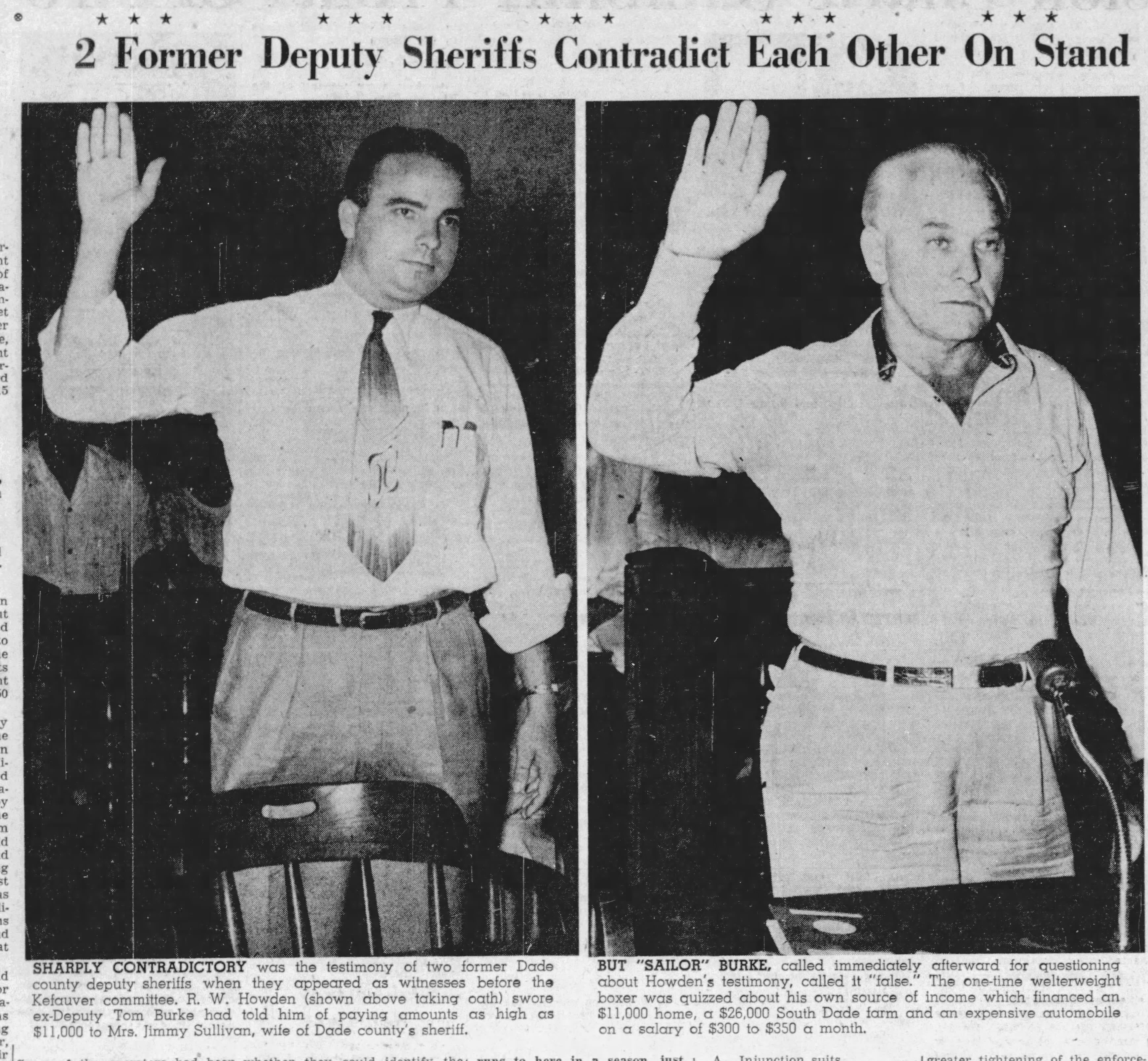
Senate Testimony

Press Coverage

Official Documents
The Testimony: July 13, 1950
A Closer Look at His Role in the Miami Field Hearings
On July 13, 1950, Richard "Dick" Howden appeared before the United States Senate Special Committee to Investigate Organized Crime in Interstate Commerce during their field hearings in Miami, Florida. By this time, he had transitioned from his role with the Dade County Sheriff's Office to working as an investigator for Equitable Life Assurance Company, but his intimate knowledge of law enforcement operations in Miami-Dade County made him a valuable witness.
The Context of His Testimony
The Kefauver Committee's investigation into Miami came at a critical time. South Florida had become a major hub for organized gambling operations, and allegations of corruption within local law enforcement were widespread. Sheriff James A. "Smiling Jimmy" Sullivan, who had taken office in 1945—the same year Dick Howden served as Superintendent of the Bureau of Identification—was a central figure in the investigation.
Dick Howden's testimony was particularly significant because he had served in a leadership position within the very department now under scrutiny. As Superintendent of the Bureau of Identification and investigator in the Homicide Bureau from September 15, 1945, through 1949, he had firsthand knowledge of the department's operations, policies, and the relationship between law enforcement and organized crime elements in the area.
What Made His Testimony Extraordinary
Several factors made Dick Howden's appearance before the committee remarkable:
Professional Risk: Though he had left the Sheriff's Office by 1950, testifying about his former colleagues and superiors required courage. The law enforcement community in Miami was tight-knit, and speaking openly about departmental issues could have professional and personal consequences.
Physical Courage: Dick appeared before the committee despite the physical challenges that would later require him to wear leg braces on both legs. Even in 1950, his mobility issues were significant. The fact that he navigated his disabilities while maintaining the moral courage to testify speaks to his character.
Insider Knowledge: His roles as Superintendent of the Bureau of Identification and Homicide investigator gave him unique insight into how the department functioned, what records existed, how investigations were conducted (or not conducted), and the relationships between law enforcement officials and known criminals.
Timing: His testimony came during the same hearings where other witnesses—including Sheriff Sullivan himself—presented conflicting accounts of gambling operations and law enforcement responses in Dade County. The presence of a former high-ranking official willing to provide truthful testimony added crucial credibility to the committee's investigation.
The Divided Department
The hearings revealed a stark division within the Dade County Sheriff's Office. While some officials, like Dick Howden, provided honest accounts of conditions and operations, others defended Sheriff Sullivan and minimized the extent of gambling and corruption. This division illustrated the difficult position faced by honest law enforcement officers during this era—caught between loyalty to their colleagues and commitment to truth and justice.
Dick Howden chose truth. His decision to testify honestly, even when it meant contradicting his former superior and potentially alienating former colleagues, exemplified the principles that had guided his entire career in law enforcement.